The ToyotaSports Car Showdown: Unpacking the Future of Speed and Innovation
The automotive world is abuzz with the unveiling of Toyota’s new “Holy Trinity”—a trio of high-performance vehicles poised to redefine the landscape of speed, technology, and driver engagement. These aren’t just new models; they represent a philosophical declaration from Toyota Motor Corporation (TMC). Led by the legendary “Master Driver” Akio Toyoda, this initiative marks a decisive moment for Gazoo Racing (GR), Lexus, and Toyota as a whole.
At the heart of this announcement are three distinct but interconnected players: the Lexus LFA Concept, the GR GT, and the GR GT3 race car. Together, they symbolize something profound in Japanese culture: Shikinen Sengu. This ancient Shinto ritual involves rebuilding the most sacred shrines every few decades, passing down ancestral craftsmanship and tradition to the next generation. For Toyota, this means preserving core car-making skills while embracing the latest technologies to create a new generation of automotive masterpieces.
This ambitious push comes at a critical juncture. The automotive industry is undergoing a radical transformation, driven by the inexorable shift towards electrification and the rise of high-performance, AI-driven rivals from China. By tasking its brightest engineers with building these high-profile machines—each with a unique powertrain—Toyota is not just investing hundreds of millions of dollars; it’s investing in the future of its people and its legacy.
Let’s delve into what we know about these groundbreaking vehicles and what they portend for the future of performance driving.
The GR GT: A 641-HP Hybrid Predator
The GR GT is the production model slated for 2027, serving as the homologated road-legal counterpart to the radical GR GT3 race car. Built on an all-new, all-aluminum spaceframe chassis—a first for Toyota—this machine promises to combine lightweight agility with brutish power.
Performance and Powertrain: The Fiendishly Complex Heart
Under the skin, the GR GT is a technological marvel. It utilizes a sophisticated hybrid powertrain that combines a potent twin-turbocharged V8 with an advanced electric drive system. Toyota claims a staggering 641 horsepower and 627 lb-ft of torque. But power is only half the story. The truly unique element is the mechanical limited-slip differential (LSD) working in conjunction with an eight-speed dual-clutch transmission.
This specific configuration allows for incredible versatility. Unlike EVs, the GR GT offers a raw, visceral driving experience, complete with the ability to execute thick black burnouts and eye-watering drifts. Doi-san confirmed that the team is developing multiple driving modes, though details remain scarce. A glance at the steering wheel offers clues: a knob labeled ‘Sport Boost’ suggests a nitrous-like surge of power, while a separate ‘TRC/VSC Off’ button indicates drivers have full control to turn off traction and stability aids—essential for true performance enthusiasts.
Drivetrain Innovation: Why the “U-Turn”?
The powertrain layout itself is a strategic statement. By routing the power to a rear-mounted transaxle and then using a differential to send it forward to the LSD, Toyota engineers create a compact, driver-centric package. While this sounds complex, the team claims it reduces the overall powertrain length.
However, many believe this architectural choice is more than just packaging. Toyota is making a bold statement against the growing simplification of EV powertrains. They are signaling that they understand the complexity of high-performance ICE and hybrid systems and are embracing it rather than shying away. This is a flex of manufacturing might, showing that Toyota can build incredibly sophisticated machines that rival the best of Germany and Italy.
Pricing and Market Positioning
Given its performance metrics—a curb weight of 3,858 lbs and 641 hp, resulting in a power-to-weight ratio of 6.0 lb/hp—the GR GT fits squarely into the ultra-high-performance GT market. When compared to rivals like the Porsche 911 GT3 ($235,500), Porsche 911 Turbo S ($275,650), AMG GT Pro 4Matic ($202,200), and Aston Martin Vantage S ($235,000), it’s clear that the GR GT will command a premium price. It is highly probable that the road-going GR GT will debut with a price tag north of $200,000.
Future Variations and the Nürburgring Chase
When asked about future variants—such as a Nürburgring Edition, GRMN, or GT3 RS version—chief program manager Doi-san remained coy, stating, “Obviously we can’t talk about future product, but variations and improvements is something we’re always looking for.”
This modesty belies the true ambition driving the GR GT: redemption at the Nürburgring. Akio Toyoda spoke at length about the “humiliation” of being passed by faster cars at the legendary German track. While Doi-san wouldn’t confirm specific lap times, the commitment to proving themselves is palpable. With competitors like the Mustang GTD (6:52), Corvette ZR1 (6:50), and ZR1X (6:49) all dipping under the seven-minute mark, the GR GT is undoubtedly targeting a similar benchmark. Given Toyota’s engineering prowess and the aggressive specifications of the car, a sub-7-minute time is not just possible—it’s the mission.
The GR GT3: Racetrack Dominance and Technology Transfer
The GR GT3 race car is the homologation base for the road car, but it’s also a serious piece of hardware designed to win at the highest levels of motorsport. Built to compete in GT3 endurance racing, this car represents Toyota’s commitment to proving its performance credentials on the world stage.
Race Car DNA
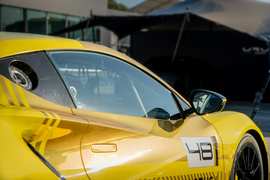
While the road car will offer comfort and luxury, the GR GT3 is stripped down, aerodynamic, and uncompromising. It features extreme downforce, massive aerodynamic elements, and racing-spec components that transform the chassis into a track weapon.
The connection to the road car is vital. By having a race car before the production car, Toyota ensures that the road version is built from a proven, battle-tested platform. This is standard practice for manufacturers like Porsche and Aston Martin, and it signals that Toyota isn’t playing games—they are serious about dominating GT3 racing.
Motorsports at the Forefront: TGR and F1
The launch of the GR GT3 coincided with a major announcement from Gazoo Racing (TGR): its new title sponsorship of the Haas Formula 1 team, which is now officially TGR HAAS Formula 1. This move places Toyota squarely in the center of the pinnacle of motorsport, competing alongside Audi, Cadillac, and Ford.
For years, Toyota has maintained a strong presence in diverse disciplines, including Le Mans, WEC, NASCAR, and WRC. However, the move into F1 is a definitive statement. It’s a strategic play to burnish the GR brand image globally and to prove that Toyota can not only build reliable daily drivers but also world-class performance vehicles that compete with the best.
Furthermore, this signals a stark contrast to the rising powerhouses of the Chinese automotive industry. While Chinese OEMs are rapidly capturing market share with affordable EVs, they are conspicuously absent from top-tier motorsports. Toyota is positioning itself as a legacy manufacturer with a global racing pedigree that goes far beyond electric batteries.
The Lexus LFA Concept: The Return of the EV Supercar
Perhaps the most anticipated and enigmatic of the trio is the Lexus LFA Concept. This is the spiritual successor to the legendary V10 supercar, but with a twist: it is fully electric.
The Waiting Game: Why is the LFA Taking So Long?
When asked about the production timeline, Lexus representatives only offered the vague phrase “several years.” This delay has fueled speculation about the technological hurdles involved. Doi-san acknowledged that the automotive world has changed since the original LFA debuted in 2010 at $375,000, and that returning as an EV complicates matters significantly.
The market for luxury sports coupes is already minuscule. Finding a natural competitor for an electric LFA is difficult. Existing electric luxury cars like the Lucid Air Sapphire or Rolls-Royce Spectre don’t quite fit the profile. The true hypercar realm of the Rimac Nevera or Lotus Evija is far beyond Lexus’ price point.
A Bold Price Tag and the Solid-State Hypothesis
The original LFA was a halo product that cost nearly $445,000 for the Nürburgring Edition. For the new EV version to succeed, it must be considerably less expensive than the outgoing model. However, given its unique positioning, it will undoubtedly be one of Lexus’s most expensive vehicles.
This is where solid-state battery (SSB) technology enters the picture. No one at the unveiling would confirm this, but many suspect it is the missing piece of the puzzle. Toyota has been a leader in SSB research through its joint venture with Panasonic. If the LFA arrives with this technology, it could justify a premium price tag.
SSBs promise a significant leap forward: a 621-mile range and 10-minute charging times. For a supercar like the LFA, this technology addresses the packaging problem. Traditional lithium-ion batteries are