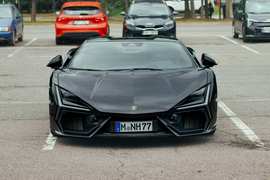
The Holy Trinity of Performance: Unpacking Toyota’s Bold Play in the Hypercar Arena
The automotive world is buzzing after Toyota’s dramatic unveiling of its new “Holy Trinity” of performance vehicles. This is not merely a refresh of existing lineups; it’s a full-blown strategic declaration from Akio Toyoda (Master Driver Morizo) and the Gazoo Racing (GR) team. By introducing the Lexus LFA Concept, the GR GT road car, and the GR GT3 race car, Toyota is flexing its manufacturing prowess, hedging its bets in the electrifying powertrain debate, and ensuring that generations of Japanese automotive craftsmanship don’t just survive, but thrive in the 21st century.
We had a valuable couple of hours to inspect these machines up close and sit down with key engineering leads, including Chief Program Manager Takashi Doi. While some questions met with thoughtful deflections or carefully worded non-answers, one thing became crystal clear: Toyota is planning to milk every milestone and waypoint on the journey of these cars from debut to delivery. This is a marathon, not a sprint, and the strategic implications are vast.
The GR GT: Homologated Performance for the Road
The cornerstone of Toyota’s new performance strategy is the GR GT. Billed as the road-going counterpart to the GR GT3 race car, this machine is slated for a 2027 arrival, likely hitting the market as a 2028 model. While this timing might suggest a later debut for the racer, history tells us otherwise—think the latest Ford GT, which saw extensive racing before its road homologation was complete.
Pricing and Market Position
Pricing for the GR GT has been a subject of intense speculation. When pressed, Doi-san pointed to established benchmarks in the high-performance segment, such as the Porsche 911 GT3 and Mercedes-AMG GT. With a claimed 641 horsepower and a curb weight of 3,858 pounds, the GR GT achieves a weight-to-power ratio of 6.0 lb/hp. Let’s look at how this stacks up against its peers:
| Vehicle | Curb Weight | Horsepower | Weight/Power | Base Price |
| :— | :— | :— | :— | :— |
| 2028 Toyota GR GT | 3,858 lb | 641 hp | 6.0 lb/hp | N/A |
| 2026 Porsche 911 GT3 | 3,278 lb | 502 hp | 6.2 lb/hp | $235,500 |
| 2026 Porsche 911 Turbo S | 3,859 lb | 701 hp | 5.5 lb/hp | $275,650 |
| 2026 AMG GT Pro 4Matic | 4,299 lb | 603 hp | 7.1 lb/hp | $202,200 |
| 2026 Aston Martin Vantage S | 3,847 lb | 671 hp | 5.7 lb/hp | $235,000 |
Indicates all-wheel-drive (AWD) configuration
Based on this competitive set, it is highly probable that the GR GT will command a price north of $200,000. This positions it squarely in the ultra-premium performance segment, competing with the most prestigious brands in the world.
Powertrain Philosophy: Hybrid Complexity
The GR GT features a fiendishly complex hybrid powertrain that includes a mechanical limited-slip differential (LSD). This design choice ensures not just high levels of driver engagement but also the kind of tire-scorching shenanigans motorsport enthusiasts crave—epic burnouts, smoky donuts, and eye-watering drifts.
Doi-san confirmed that the engineering team is developing multiple driving modes, though he wouldn’t specify names. A look at the steering wheel provides clues, specifically a knob labeled ‘Sport Boost.’ Complementing this on the lower left is a ‘TRC/VSC’ (Traction Control/Vehicle Stability Control) button marked ‘Off.’ When asked about disabling these systems, Doi eventually confirmed that drivers would have the option to turn traction and stability control off completely.
Looking ahead, we inquired about potential higher-performance variants, such as a Nürburgring Edition (echoing the LFA’s end-of-life run), GRMN, GT R, or GT3 RS. Doi-san replied, “Obviously we can’t talk about future product, but variations and improvements is something we’re always looking for. And that’s crucial, very important for a sports car.” This coy response essentially signals that the GR GT platform is designed for growth, with potential for higher-output versions in the future.
Nürburgring: Humiliation as the Catalyst
Perhaps the most compelling narrative surrounding the GR GT stems from Akio Toyoda’s opening remarks. Standing before a massive screen displaying the word ‘HUMILIATION,’ he spoke at length about Toyota’s recent development laps at the Nürburgring Nordschleife. In previous years, Toyota’s sports cars, including a fourth-generation Supra, were reportedly being passed by faster, better-handling competitors, largely from German manufacturers.
This humbling experience serves as the primary driver for the GR GT and GT3 development. When questioned about the importance of the Nürburgring and specific lap time targets (like the sub-7-minute benchmarks set by the Mustang GTD, Corvette ZR1, and ZR1X), Doi-san remained guarded. However, he strongly affirmed the ’Ring’s significance to Toyota, the GR brand, and the company’s motorsports programs. He reiterated Akio’s assertion that the GR GT will not be the car getting passed on the Green Hell. Given the notorious competitiveness of Japanese engineers and the existing benchmarks, this is essentially a declaration that the GR GT will achieve a sub-7-minute lap, especially considering current 911 GT3 and AMG GT models have already surpassed that milestone.
The Lexus LFA: Reimagining the Electrified Icon
If the look of the LFA has captured your imagination, the timeline and pricing will likely temper your excitement. Toyota representatives, including Doi-san, repeatedly stated that the new LFA is “several years” away.
The Pricing Paradox
How much will the new LFA cost? The short answer is: considerably less than the original. The 2010 LFA debuted at a shocking $375,000, and its Nürburgring Edition exit price was a staggering $445,000.
Doi-san conceded that the world has changed since the V-10 supercar departed. Introducing the LFA as an electric vehicle (EV) complicates matters, and this seems to subtly imply that the next-generation LFA needs to be priced under $350,000.
However, we believe the price must be substantially lower for a few reasons. The luxury sports coupe market is already minuscule, and there are currently no electric sports coupes priced above $200,000. While there are a few electric luxury and performance cars exceeding $200,000—such as the Lucid Air Sapphire, Rolls-Royce Spectre, and Cadillac Celestiq—none fit the precise competitive profile of the LFA. Stepping into the electric hypercar realm of the Rimac Nevera and Lotus Evija puts you in the $2.3 to $2.4 million range, which is decidedly not Lexus territory. The only model that comes close to the mission Lexus is attempting is the second-generation Tesla Roadster, rumored to be in the $200,000 to $250,000 range—if Elon Musk’s vaporware ever materializes.
Solid-State Batteries: The Game-Changer?
There is one complicating factor that could render the LFA a very pricey, and exotic, luxury sports flagship for Lexus: if it arrives with solid-state battery (SSB) technology. No one at the event confirmed this rumor under direct questioning, but it is a very strong possibility.
What we do know is that Toyota has been working on solid-state batteries since 2020, following a joint venture with Panasonic named Prime Planet Energy & Solutions, Inc. In 2024, Toyota updated its battery roadmap, showing SSB technology arriving between 2027 and 2028. These batteries are projected to offer a range of 621 miles (1000 km) and recharging times of approximately 10 minutes.
Obviously, this level of battery performance represents a massive technological leap, which is exactly what Lexus may be seeking in its flagship sports car. Furthermore, it could solve a major packaging problem for the electric LFA.
Packaging the Future: A Solution Hiding in Plain Sight
The current best practice in global EV manufacturing involves placing heavy battery cells, bundled in packs or modules, as low as possible in the vehicle’s floor. This is known as a skateboard chassis, pioneered in production by the Tesla Model S, and used by virtually every major EV since. Placing the battery low keeps the center of gravity down, providing that planted feeling when changing direction.
For the LFA’s production engineers, however, this presents a significant hurdle. The shared all-aluminum spaceframe chassis of the GR GT, GR GT3, and LFA Concept lacks a traditional