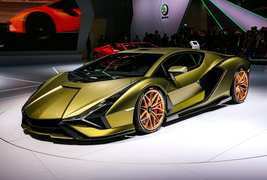
Toyota’s All-Electric Future: The Shockwave of the New LFA and the GR Trinity
The automotive world is buzzing with anticipation following Toyota’s latest unveiling of its new sports car “holy trinity.” This isn’t just a refresh; it’s a strategic declaration of intent, a commitment to preserving the art of performance while embracing cutting-edge technology. As industry observers pore over every detail of the Lexus LFA Concept, GR GT, and GR GT3 race car, the underlying message is clear: Toyota is preparing for a bold new era in performance motoring, blending visceral driving experiences with the electrifying promise of the future.
This isn’t merely a showcase of new metal; it’s a deeply personal initiative by Akio Toyoda, the driving force behind Toyota Gazoo Racing (TGR). His vision, centered on the traditional Japanese philosophy of “Shikinen Sengu,” speaks to the cyclical renewal of spiritual and architectural spaces, but Toyota applies this concept to the very soul of car manufacturing. It represents a commitment to preserve fundamental car-making skills while integrating new technologies, ensuring that the passion for performance lives on for generations to come.
For those who have long revered the legacy of the original Lexus LFA—a V10 supercar that defied convention with its lightweight carbon fiber construction and spine-tingling exhaust note—the announcement brings both excitement and a healthy dose of pragmatism. While Toyota remains coy about exact specifications and timelines, the GR twins, particularly the GR GT3 race car, offer compelling glimpses into what the future holds. This move by Toyota signals a profound shift, one that acknowledges the seismic changes in the automotive landscape while reaffirming the company’s position at the vanguard of performance innovation.
The GR GT: A Pure-Play Track Weapon Built for the Masses
Perhaps the most accessible of this trio of performance machines is the Toyota GR GT. Designed as a homologation-ready race car, this vehicle is intended to be more than just a showcase of Toyota’s engineering prowess. It represents the future of GT racing, one that promises a thrilling driving experience that can be pushed to its limits without the anxiety of expensive component failure.
Pricing and Availability: Targeting the Premium Segment
While Toyota has kept precise pricing under wraps, market analysts and industry insiders agree that the Toyota GR GT is likely to be a formidable player in the premium sports car segment. Drawing comparisons to established rivals such as the Porsche 911 GT3 and Mercedes-AMG AMG GT, the GR GT is projected to sit well above the $200,000 mark. The projected curb weight of 3858 pounds combined with a 641 horsepower output delivers a weight-to-power ratio of 6.0 lb/hp. This places it directly in competition with high-performance GTs that command prices well north of the six-figure mark.
For example, the 2028 Toyota GR GT is poised to be priced in the same ballpark as the 2026 Porsche 911 GT3 (502 hp, 6.2 lb/hp, $235,500), the 2026 Porsche 911 Turbo S (701 hp, 5.5 lb/hp, $275,650), and the 2026 Aston Martin Vantage S (671 hp, 5.7 lb/hp, $235,000). Even the 2026 AMG GT Pro 4Matic (603 hp, 7.1 lb/hp, $202,200) serves as a benchmark for this high-performance niche. If this competitive set is any indication, it seems highly likely the GR GT will be priced at more than $200,000.
The timeline for the GR GT’s arrival is slated for 2027, likely to hit showroom floors as a 2028 model. This serves as the homologation basis for the GR GT3 race car, which is expected to debut shortly thereafter. However, based on historical patterns such as the Ford GT, race cars often hit the track well before their road-legal counterparts become available to the public. This staggered approach allows for extensive testing and validation in the heat of competition.
Fiendish Mechanical Complexity: A Hybrid Powertrain Masterpiece
One of the most intriguing aspects of the Toyota GR GT is its electromechanical complexity. The powertrain is a symphony of engineering ingenuity, featuring an all-aluminum engine with forged internals (pistons, rods, and cross-plane crankshaft). Twin turbochargers are nestled within the valley of the 90-degree cylinder banks, delivering a claimed 641 horsepower and 627 lb-ft of torque.
This formidable power is channeled through a carbon-fiber-reinforced plastic (CFRP) “torque tube\” to a rear-mounted transaxle. At the rear of the transmission, a set of conical gears directs the hybridized power forward to a mechanical limited-slip differential (LSD). The LSD then distributes torque to the rear wheels via half shafts.
Toyota engineers justify this elaborate routing by claiming it reduces the overall length of the powertrain. However, the deeper motive likely ties back to Akio Toyoda’s vision. As automakers increasingly move towards simplified electric powertrains, Toyota is asserting its manufacturing might by building complex high-performance vehicles with unique drivelines. This isn’t just a technical flex; it’s a statement that Toyota intends to continue pushing the boundaries of automotive engineering.
Performance Modes and Future Variants
The GR GT promises a highly engaging driving experience, and its design clearly accommodates tire-smoking antics. With a mechanical LSD, the potential for smoky donuts, long drifts, and thick black burnouts is certainly on the table. Toyota has confirmed that they are working on different driving modes, although the specific names of these modes remain undisclosed.
A peek at the steering wheel provides some clues. A knob on the right side is labeled “Sport Boost,” suggesting a supplementary power output mode. On the lower left side, a button for traction and stability control is marked “TRC/VSC” with an \”Off\” option. When pressed about whether drivers would be allowed to disable traction and stability control completely, project manager Doi eventually confirmed that they would.
Looking ahead, the question of future variants has been raised. Would we see a Nürburgring Edition, GRMN (Meister of Nürburgring), GT R, or GT3 RS version of the GR GT? While officials were tight-lipped about future product, the company’s history suggests they are always looking for ways to refine and improve their sports cars. This focus on performance evolution is crucial for the longevity of the GR brand.
Nürburgring Nordschleife: From Humiliation to Redemption
No conversation about Toyota’s performance ambitions is complete without addressing the Nürburgring Nordschleife, or the Green Hell. When Akio Toyoda unveiled the GR GT and GR GT3, he stood before a massive video wall displaying the word \”Humiliation\” in bold capital letters.
Toyoda spoke at length about the humbling experience of leading development laps at the Nürburgring in Toyota sports cars—including a fourth-generation Supra—only to be consistently overtaken by faster, better-handling competitors, primarily from Germany. This very notion of using humiliation as a catalyst for improvement drives the development of the GR GT and GT3.
When asked about the importance of the Nürburgring and whether the team is targeting a specific lap time, such as the sub-7-minute benchmarks set by the Mustang GTD (6:52), Corvette ZR1 (6:50), and Corvette ZR1X (6:49), Doi remained cautious, unwilling to explicitly confirm a target. However, he strongly affirmed the significance of the ‘Ring to Toyota, the GR brand, and the company’s motorsport programs. He reiterated Toyoda’s assertion that the GR GT would not be the one left behind on the Green Hell.
Given the characteristic modesty and humility of Japanese automotive engineers, this statement is essentially a declaration that the GR GT will achieve a sub-7-minute lap. This is especially plausible when considering that various 911 GT3 and AMG GT models have all surpassed this barrier. The GR GT is not just aiming to compete; it’s aiming to dominate.
The Lexus LFA Concept: A Potential Solid-State Battery Flagship
For fans of the Lexus LFA, the reveal of the Lexus LFA Concept brings renewed hope for a return of this iconic supercar. However, anyone looking for a clear timeline or price has likely been met with a degree of disappointment. \”Several years\” was the consistent refrain from Toyota representatives, including Doi-san.
The world has changed since the original LFA—a V10 supercar that debuted in 2010 at a staggering $375,000 and exited the market two years later at $445,000 for the LFA Nürburgring Edition. Doi-san conceded that the landscape is vastly different today, and the transition to an EV complicates the path forward. This subtly implies that the next-generation LFA will need to be considerably less expensive than the original, likely below the $350,00