The Five Porsches That Defined a Driving Career: An Insider’s Perspective
For four decades, I’ve had the privilege of driving some of the world’s most remarkable automobiles. But throughout my career, one car has remained a constant obsession: the Porsche 911. Over the years, I’ve test-driven countless variants, from early, unfiltered models to the latest technological marvels. While the 911 has evolved significantly, it has never lost its essential character. If I were to spend my own money today, a 911 would still be at the top of the list.
My journey began with a white 3.0-liter Carrera, a raw, visceral machine with no power steering and a five-speed manual. It was fast, but raw. That experience taught me the fundamental truth about the 911: it’s not a car that conforms to the driver; it’s a car that demands respect. It takes an understanding of its balance, its limitations, and its rewards.
Over the past 40 years, Porsche has refined the 911 without compromising the core philosophy that made it legendary. Each generation has pushed the boundaries of performance, technology, and driver engagement. Here are the five Porsche 911 models that have left the most indelible mark on me.
The Original 911 Turbo (930)
When I first heard veterans speak of the original 911 Turbo, I imagined a car that was brutishly powerful and utterly unforgiving. It was often referred to as a “widowmaker,” a car that rewarded aggressive driving with instant, dramatic torque. It wasn’t until 35 years after I first encountered the 911 that I finally got behind the wheel of an original Turbo.
This particular car was one of the first 30 production models ever built, now part of Porsche’s classic fleet. Aware of its fearsome reputation, I approached it cautiously at first, testing the throttle and watching the tachometer to understand how the power curve behaved. The engine was surprisingly tractable at low RPMs, comfortable at 2,000 revs in top gear, which is impressive for a 50-year-old car. But once the engine hit 3,500 RPM, the turbocharger would spool up and deliver a significant surge of acceleration.
The key to taming the 930 is keeping the engine spinning above 4,000 RPM to keep the turbo energized. While there is noticeable turbo lag by modern standards, it’s manageable. Even today, this 911 is incredibly fast on the road. First gear reaches 50 mph, second gear reaches 90 mph, and third gear nears 130 mph. This means that you can destroy any winding two-lane road using only second and third gears. And even though it has only 256 hp, it weighs only 2,513 pounds, so it corners exceptionally well. Fifty years ago, its performance was otherworldly.
The 993-Generation Porsche 911
For purists, the 993 is the last of the “real” 911s. It is a car that brings the gnashing, metallic clatter of an air-cooled flat-six to the forefront. But when I first drove it in 1994, the 993 was the 911 of the future, the first iteration to challenge the laws of physics.
The 993 still had the typical 911 front end that required careful loading at corner entry to ensure proper apex tracking and the rear end would wiggle through rough corners. However, there was much more simpatico between the front and rear. The 993 continued to do things that made a 911 a 911, but with a much better margin of error.
The new multilink rear suspension was the key development. It replaced the old semi-trailing arms and allowed for slight initial toe-out on corner entry and then progressive toe-in as lateral loads increased, all while reducing the camber change that was the Achilles’ heel of 911s since 1963. This was combined with steering that turned 16% quicker, at 2.5 turns lock-to-lock, making the front end feel much more precise. Additionally, a new six-speed manual transmission made the most of the 3.6-liter flat-six, which revved harder to its 268 hp peak at 6,100 rpm thanks to lighter internal components, Bosch Motronic 2.0 engine management, and a new dual exhaust system.
Compared to the 964 model it replaced, the 993 was a revelation. It wasn’t just the engineering upgrades, which were led by Ulrich Bez, who later became the head of Aston Martin: The exterior redesign, executed under design chief Harm Lagaay, corrected the visual flaws of the 964, a car he thought was too tall at the front and too pulled down at the rear. The interior was cleaner, with fewer buttons in random locations. The 993 was a 911 that was faster and more forgiving than ever. And, most importantly, it was more desirable, too.
The 996-Generation Porsche 911
At the time, the 996-generation 911 was nothing short of heresy. Porsche’s decision to install a water-cooled flat-six in the tail of the 996 was, to the aficionados, the automotive equivalent of Bob Dylan ditching his acoustic guitar and picking up a Fender Stratocaster at the 1965 Newport Folk Festival. But the 996, the first clean-sheet redesign of Porsche’s indefatigable sports car in 34 years, was a hero car to me. It was the 911 that saved Porsche.
Engineered and developed under the leadership of Porsche R&D chief Horst Marchart, the 996 was a clever 911, not least because it shared 38% of its parts with an all-new, less expensive mid-engine roadster the world would come to know as the Boxster. Iconoclastic Porsche boss Wendelin Weideking knew the Boxster was needed to give dealers something else to sell when the aging 928 and 968 models went out of production. “We did two cars for the price of one-and-a-half,” design boss Lagaay said with a smile after the company unveiled the 996.
But while media attention focused on its relationship with the Boxster and the water-cooled engine, the 996’s real story ran much deeper. In 1994, it had taken Porsche 130 hours to build a 993-series 911; the 996 took just 60 hours to build. The modern 911 had arrived: roomier and equipped with all the features expected of a late 20th-century sports car but still recognizably Porsche’s icon. Most important, it still drove like a 911. Only better. Yes, there was a new veneer of sophistication to the way it went about its business, but the 996 retained the delicious tactility and urgent response that had made the 911 a sports car like no other. And along with that original Boxster, it saved Porsche from extinction.
The 991.2-Generation Porsche 911 Carrera
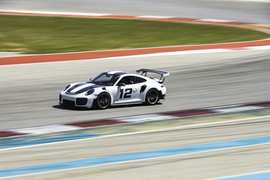
Of all the 911s I’ve driven, it was a base 991.2 Carrera that truly stole my heart. It stole everyone else’s too, judging from the feedback I got at the time from colleagues who drove it. Most press fleets tend to be stacked with high-spec vehicles loaded with options, presumably because automotive PRs think we’re impressed by such things. So Porsche Cars North America’s decision to include a base 911 Carrera among the roster of then-new 991.2 models available for our 2017 MotorTrend Car of the Year testing seemed a brave one. In truth, though, it was an inspired move.
The 991.2 bowed a new 3.4-liter turbocharged engine, available with 370 hp in the base Carrera or 420 hp in the Carrera S. Even in 370 hp trim, it delivered a broad band of torque and impressive efficiency. This Carrera also showed that even on the base wheel/tire combo the chassis was staggeringly communicative and adjustable. Visually, the 991.2 was a mild refresh of the bigger, skillfully reproportioned 991.1, a superbly executed interpretation of classic 911 themes, modern and beautiful. Inside was a new infotainment interface that looked great and worked well.
Porsche’s PDK dual-clutch automatic remains a benchmark transmission in terms of its smooth, precise shifts. But the seven-speed stick shift on the no-frills Carrera delighted with an oily rifle-bolt action that made us all fall in love with driving again. MotorTrend’s testing director at the time, Kim Reynolds, spoke for all the COTY judges when he summed up the Carrera’s visceral appeal: “When all cars but one are autonomous, please let this be it, the last human-driven car. For posterity’s sake.” It’s been 10 years since I drove it, but I