Electric Rebellion: The Hybrid Supercars Redefining Performance in 2025
For too long, the term “hybrid” was synonymous with the mundane, the fuel-sipping commuter that sacrificed excitement on the altar of efficiency. The early aughts cemented this perception, largely thanks to the widespread popularity of the Toyota Prius. For enthusiasts, “hybrid” quickly became a synonym for “boring.”
But the automotive landscape has undergone a seismic shift. Today, everything from daily drivers to the most extreme hypercars utilize electrification in some form. And as the appetite for battery-electric vehicles cools, hybrid technology is finding new relevance in the performance sector. What’s exciting for car lovers is the surge in ultra-high-performance hybrid vehicles that prove electrification can pack serious attitude and jaw-dropping speed.
We’ve witnessed the dawn of a new era in automotive engineering. The lines between traditional combustion and electric power have blurred, giving rise to machines that deliver the visceral thrill of analog power with the instant torque and brutal acceleration of electric motors. Forget the eco-box stereotypes; these are cars built to challenge supercars, dominate race tracks, and redefine what we thought was possible on four wheels.
If you think hybrids are a compromise, prepare to have your preconceptions shattered. These vehicles represent the pinnacle of automotive technology, blending cutting-edge performance with the efficiency and torque delivery that only electrification can provide.
The New Guard: Performance Hybrids Dominating the Road in 2025
The current crop of hybrid supercars isn’t just fast; they’re technologically revolutionary. These machines leverage hybrid systems not just to improve fuel economy, but to unlock levels of power and responsiveness that were previously unimaginable. Let’s explore the top contenders that prove hybrids are anything but boring.
Chevrolet Corvette ZR1X: American Brutality Meets Electric Fury
Corvettes have a long-standing reputation for punching above their weight class, but the ZR1X represents a dramatic escalation of that philosophy. This isn’t your grandfather’s Corvette; it’s a full-blown hypercar designed to annihilate lap times and humiliate exotics costing multiple times its price.
Powering the ZR1X is the beastly 5.5-liter twin-turbo flat-plane crank V-8 from the legendary ZR1, enhanced by an advanced version of the Corvette E-Ray’s hybrid system. The result is a monumental 1,250 horsepower and 973 lb-ft of torque. This output rockets the ZR1X from 0 to 60 mph in a stunning sub-1.7 seconds.
The true measure of its capability was proven at the legendary Nürburgring in July 2025. The ZR1X laid down a blisteringly fast lap time of 6:49.275, making it the fastest American production car ever to conquer the Green Hell. This feat alone cements its place among the world’s elite performance machines.
While the $207,305 base MSRP makes it the most expensive production Corvette in history, its staggering performance offers an incredible performance bargain. It proves that the American spirit of competition has fully embraced hybridization, delivering a hypercar that challenges the established European order.
Porsche 911 GTS T-Hybrid: The Evolution of an Icon
For years, Porsche purists feared the day when the iconic 911 would embrace hybridization. But the 2025 911 GTS T-Hybrid has shown that the “P-car” faithful had little to worry about. This isn’t a compromise; it’s an evolution that enhances the very essence of the 911 driving experience.
Unlike other hybrid models, the 911 GTS T-Hybrid offers no all-electric driving range. With a tiny 1.9-kWh battery pack, the weight penalty is virtually imperceptible from behind the wheel. What is immediately noticeable, however, is the elimination of turbo lag.
Porsche ingeniously integrated an electric motor directly into the turbocharger’s design. This motor can spin the turbo at any speed, independent of exhaust gas flow, providing instantaneous boost pressure. Furthermore, the energy recovered by the eTurbo system is used to recharge the battery, and the stored energy assists the engine through the gearbox’s electric motor.
The results are profound: instant throttle response, seamless power delivery, and a level of refinement that makes driving the GTS T-Hybrid an almost ethereal experience. The fact that you wouldn’t even know it’s a hybrid without reading the badge speaks volumes about how seamlessly Porsche has integrated electrification into its most beloved sports car. It proves that hybridization can enhance, rather than diminish, the purity of the driving experience.
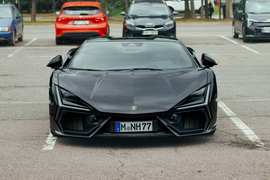
Lamborghini Revuelto: Where the Raging Bull Meets the Electric Age
Lamborghini’s successor to the legendary Aventador has achieved something remarkable: it joins the 1,000-horsepower club without sacrificing its iconic naturally aspirated V-12 engine. The Revuelto achieves this feat thanks to its plug-in hybrid system, a masterpiece of Italian engineering that combines raw power with cutting-edge technology.
Two electric motors drive the front wheels, while a third is integrated into the flagship’s eight-speed dual-clutch transmission. This third motor assists the mighty 6.5-liter V-12, which revs to nearly 10,000 rpm and helps keep the 3.8-kWh lithium-ion battery pack topped off during hard driving.
Beyond its staggering performance, the Revuelto is a revelation in daily usability. Where the Aventador suffered from a woefully unrefined automated single-clutch transmission, the Revuelto is a completely different animal. The new dual-clutch gearbox provides a seamless, buttery-smooth experience in everyday driving, while the hybrid system ensures consistent power delivery.
Combined with vastly improved ergonomics and unmistakable Lamborghini flair, the Revuelto is a seriously compelling Italian hybrid. It offers the visceral thrill of a naturally aspirated V-12 paired with the responsiveness of electric power, all packaged in a design that defies automotive conventions. It requires very few compromises—provided your pockets are deep enough.
Aston Martin Valkyrie: Le Mans Performance for the Road
The Aston Martin Valkyrie looks more like a Le Mans prototype than a road-legal car, and that’s by design. This jaw-dropping halo car is a brutal symphony of form and function, a street-legal hypercar that delivers unparalleled performance.
At its heart lies a 6.5-liter naturally aspirated V-12 that generates 1,001 horsepower on its own and revs to a searing 11,000 rpm. This monster mill is supplemented by a KERS-style hybrid setup that adds another 141 hp and 207 lb-ft of torque, for a total system output of 1,139 horsepower and 682 lb-ft of torque.
All this power is sent to the rear wheels in a car with a curb weight of less than 3,000 pounds, making it one of the lightest and most powerful hybrid hypercars ever built.
The Valkyrie’s aero figures are equally staggering: 2,425 pounds of downforce between 137 and 220 mph—nearly half a ton more than a Formula 1 car. This extreme machine provides an unadulterated, visceral driving experience that pushes the boundaries of what a road car can achieve. It is an extreme testament to the power of hybrid engineering when applied without compromise.
Mercedes-AMG S63 E Performance: Executive Comfort Meets Devastating Thrust
We often associate the Mercedes S-Class with opulent amenities and future tech, but the S63 E Performance proves that AMG has redefined this legendary sedan. While its handsome exterior and refined cabin exude executive comfort, the devastating thrust delivered by this hybrid is guaranteed to catch even the most seasoned drivers off guard.
The S63 E Performance utilizes a 4.0-liter twin-turbo V-8 paired with a hybrid system that produces 201 hp and 236 lb-ft on its own. Combined, these systems deliver a staggering output of 791 hp and 1,025 lb-ft of torque. This prodigious grunt is sent to all four wheels, enabling this luxury behemoth to rival supercars like the Lamborghini Huracán in the 0-60 mph sprint.
Despite a curb weight of nearly 6,000 pounds, the S63 E Performance maintains remarkable composure when the going gets twisty. It achieves this precision without resorting to an overly abusive suspension tune, proving that hybrid technology can deliver brutal power while retaining the sophisticated comfort expected of an S-Class. It is a masterclass in hybridization that defies expectations.
Audi RS6 Avant: The Hyper-Wagon Reimagined
The fourth-generation Audi RS6 Avant isn’t a hybrid in the traditional sense, but its mild hybrid 48-volt belt alternator starter system represents a significant step toward electrification. This system can harvest and store up to 12 kW of electrical energy, enabling the stop/start system to operate at speeds of up to 14 mph.
More impressively, the RS6 has the ability to coast for up to 40 seconds with the engine off at speeds between 35 mph and 100 mph when the driver lifts off the throttle. This unique ability to glide silently at highway speeds showcases the early stages of hybrid integration in the performance wagon segment. And frankly, we’ll celebrate any opportunity to admire a 600-horsepower