



Driving the Future: Czinger 21C VMax — An Audacious Leap into Extreme Hypercar Engineering
For years, the automotive world has observed the audacious vision of Czinger, the Southern California company that has built a reputation for pushing the boundaries of what’s possible in hypercar engineering. From its early days, MotorTrend has been keenly following their journey, as highlighted by our podcast interview with founders Kevin and Lukas Czinger in October 2022. This long-held interest culminated in an exhilarating three-day road rally behind the wheel of the Czinger 21C VMax.
While there are certainly compelling stories to tell about the 21C’s track-focused variants—the hyper-aggressive, wing-laden 21C and its even more potent derivative, the VMax—we were keen to explore a different facet of this technological marvel. We wanted to understand what it’s like to live with a seven-figure hypercar that features a center-mounted cockpit, tandem seating, and a total of 1,250 horsepower. This drive, spanning over 500 miles through the vineyards of Central and Northern California, was not merely about breaking lap times; it was about experiencing the very essence of this mad-genius creation as it transitions from the factory floor to the open road.
 Factory Fresh: A Glimpse into the Future
Entering the Czinger production facility feels like crossing a threshold into a parallel automotive dimension. It’s one of the few places I’ve ever needed a passport to enter, which hints at the truly unique nature of this organization. The parent company, Divergent Technologies, operates at the absolute bleeding edge of iterative artificial intelligence and additive manufacturing. This isn’t just a car company; it’s a technology powerhouse that designs and produces some of the most advanced mechanical components ever conceived for both automotive and defense applications.
While all military components were carefully shielded from view during my visit, one machine in particular was a striking reminder of the advanced technology at play. Standing before one of Divergent’s immense 3D printers was like watching the future unfold. With mesmerizing precision, more than a dozen lasers fused powdered aluminum into automotive parts that resembled the skeletal structure of a bird. It’s an unforgettable spectacle and a stark illustration of how modern manufacturing has evolved.
Lukas Czinger explained that Divergent’s engineering philosophy reaches a state known as “Pareto optimality,” a point where any further optimization—adding or subtracting a single gram—would actually be detrimental to performance. The process they employ is fascinating: an engineer specifies a target, such as the exact shape and strength needed for a rear suspension damper’s remote reservoir, considering the constraints of available space and the incredible forces it must withstand. Using these parameters, the software iterates through hundreds of thousands of design possibilities until it generates the most lightweight and robust geometry possible. It’s akin to the evolutionary process of nature, but condensed into a matter of moments.
Beyond its pioneering role in hypercar development, Divergent supplies these revolutionary 3D-printed parts to nine major automotive OEMs. While Aston Martin, Bugatti, and McLaren are the only brands that publicly acknowledge their reliance on Divergent, many industry insiders suspect that components on cars like the Ferrari F80 are also the product of this cutting-edge technology.
Under the Carbon Fiber Hood
Czinger manufactures two distinct versions of what is fundamentally the same vehicle. The first is the 21C (named to signify the 21st century), a high-downforce, track-focused missile designed to obliterate lap records. The second is the VMax, a wingless, long-tailed variant engineered to be the absolute pinnacle of road-legal hypercar performance. For the inaugural Velocity Tour, a challenging 500-mile road rally through the picturesque wine country of Northern and Central California, I was handed the keys to a sleek, silver VMax.
I purposefully chose the word “piloting” to describe the experience because the cabin of the 21C VMax feels far more like a fighter jet cockpit than a conventional car interior. Czinger themselves claim it evokes the feeling of being in a jet fighter, and though I haven’t had the privilege of flying one, I have experienced the sensation of sitting in the rear of an Extra 330LT stunt plane. The similarity is striking: in both machines, the glass of the canopy is situated less than a foot from either side of your head, providing an unparalleled sense of immersion.
Factory Fresh: A Glimpse into the Future
Entering the Czinger production facility feels like crossing a threshold into a parallel automotive dimension. It’s one of the few places I’ve ever needed a passport to enter, which hints at the truly unique nature of this organization. The parent company, Divergent Technologies, operates at the absolute bleeding edge of iterative artificial intelligence and additive manufacturing. This isn’t just a car company; it’s a technology powerhouse that designs and produces some of the most advanced mechanical components ever conceived for both automotive and defense applications.
While all military components were carefully shielded from view during my visit, one machine in particular was a striking reminder of the advanced technology at play. Standing before one of Divergent’s immense 3D printers was like watching the future unfold. With mesmerizing precision, more than a dozen lasers fused powdered aluminum into automotive parts that resembled the skeletal structure of a bird. It’s an unforgettable spectacle and a stark illustration of how modern manufacturing has evolved.
Lukas Czinger explained that Divergent’s engineering philosophy reaches a state known as “Pareto optimality,” a point where any further optimization—adding or subtracting a single gram—would actually be detrimental to performance. The process they employ is fascinating: an engineer specifies a target, such as the exact shape and strength needed for a rear suspension damper’s remote reservoir, considering the constraints of available space and the incredible forces it must withstand. Using these parameters, the software iterates through hundreds of thousands of design possibilities until it generates the most lightweight and robust geometry possible. It’s akin to the evolutionary process of nature, but condensed into a matter of moments.
Beyond its pioneering role in hypercar development, Divergent supplies these revolutionary 3D-printed parts to nine major automotive OEMs. While Aston Martin, Bugatti, and McLaren are the only brands that publicly acknowledge their reliance on Divergent, many industry insiders suspect that components on cars like the Ferrari F80 are also the product of this cutting-edge technology.
Under the Carbon Fiber Hood
Czinger manufactures two distinct versions of what is fundamentally the same vehicle. The first is the 21C (named to signify the 21st century), a high-downforce, track-focused missile designed to obliterate lap records. The second is the VMax, a wingless, long-tailed variant engineered to be the absolute pinnacle of road-legal hypercar performance. For the inaugural Velocity Tour, a challenging 500-mile road rally through the picturesque wine country of Northern and Central California, I was handed the keys to a sleek, silver VMax.
I purposefully chose the word “piloting” to describe the experience because the cabin of the 21C VMax feels far more like a fighter jet cockpit than a conventional car interior. Czinger themselves claim it evokes the feeling of being in a jet fighter, and though I haven’t had the privilege of flying one, I have experienced the sensation of sitting in the rear of an Extra 330LT stunt plane. The similarity is striking: in both machines, the glass of the canopy is situated less than a foot from either side of your head, providing an unparalleled sense of immersion.
 The visibility, as one might expect, is phenomenal. However, the process of getting in and out of the car is undeniably unconventional and, frankly, ridiculous. You begin by sitting with your legs stretched out along the massive sill. Then, you must pull your knees up towards your chest, spin your body on your buttocks, and finally tuck your feet into the snug footwell. Once properly positioned, you have to slide your head under the roof. It’s a balletic maneuver that demands flexibility and a certain degree of athleticism—not exactly the most practical way to hop in for a quick drive to the grocery store.
One reason for the substantial width of these sills is the battery integration. The 21C VMax is a high-performance hybrid vehicle, and each sill houses 2.2 kWh of battery power, for a combined total of 4.4 kWh. This is not a plug-in hybrid; rather, the motor is powered by the mid-mounted V-8 engine, which in turn keeps the battery pack topped off. These batteries are capable of delivering a staggering 500 horsepower to the front axle, with one motor dedicated to each wheel. The combustion heart of the VMax is a Czinger-developed 2.9-liter twin-turbocharged V-8 that produces 750 horsepower on standard California 91-octane premium unleaded fuel. Should you choose to fill the tank with 100-octane race fuel, the output increases to 850 horsepower. This compact but potent engine is also capable of running on ethanol, which would unlock even higher horsepower figures; although Czinger has not officially released these figures, we predict a substantial increase of around 10 percent.
The gas engine drives the rear wheels through an Xtrac single-clutch automated semi-sequential gearbox. While this is similar to the seven-speed Xtrac transmission used in the Pagani Utopia, Czinger takes this technology a step further. Not only is the gearbox casing manufactured using additive 3D printing, but they also integrate small 48-volt electric motors to facilitate shifts at lower speeds, effectively eliminating the jerky, surging feeling characteristic of most automated single-clutch transmissions at low revs. The twin-barrel actuators perform flawlessly, as I was grateful to discover during my time in the VMax. Navigating through gas stations, restaurants, and hotel parking lots felt almost surprisingly normal. This is a remarkable engineering achievement.
Track Time: A High-Octane Thrill Ride
What never felt normal, however, was the presence of a professional driver riding shotgun with me for an entire day. In a tradition shared by many high-end hypercar manufacturers like Bugatti and Pagani, Czinger insisted that a professional driver, Evan Jacobs, accompany me to ensure I didn’t drive the $2.5 million machine off a cliff. Thankfully, later that evening, Jacobs assured the Czinger team that I posed no threat to the car and was allowed to drive solo for the remainder of the rally.
We stopped by Laguna Seca for a few parade laps, but for whatever reason, non-Czinger employees are not permitted to drive the VMax on racetracks, even at the brutally slow pace dictated by the rally regulations. As I have learned the hard way, even if you can’t drive, the experience of riding shotgun is often just as valuable. With that in mind, I scrambled into the bizarre rear seat. The first thing to note here is that if you have large calves or feet, the rear-seat experience is less than ideal. My own XXL calves were practically wedged between the carbon-fiber tub and the carbon-fiber seat, and my feet didn’t fit comfortably either. However, the visibility through the side glass is nothing short of incredible. Again, it reminded me of a stunt plane and provided a uniquely novel way to experience riding around a track—a place I have frequented countless times.
This novelty was particularly pronounced when Jacobs and I convinced the Skip Barber Racing School staff (whose track day we had essentially crashed) to let him take the VMax for a couple of “6/10ths” hot laps. The most impressive hot lap I have ever experienced was riding shotgun in an Aston Martin Valkyrie LMH race car, during which I could feel the blood pooling in my extremities under heavy braking. The Czinger 21C VMax now holds the second spot on that list, and it’s important to remember that Jacobs wasn’t even driving at full throttle. Even at something less than the limit and without the added downforce of the rear wing, it was easy to comprehend how the Czinger 21C achieved what the company calls the California Gold Rush. This achievement involved setting five production car track records at five different tracks—Thunder Hill, Sonoma Raceway, Laguna Seca, Willow Springs, and the Thermal Club—all within a single week, driving from one venue to the next.
The visibility, as one might expect, is phenomenal. However, the process of getting in and out of the car is undeniably unconventional and, frankly, ridiculous. You begin by sitting with your legs stretched out along the massive sill. Then, you must pull your knees up towards your chest, spin your body on your buttocks, and finally tuck your feet into the snug footwell. Once properly positioned, you have to slide your head under the roof. It’s a balletic maneuver that demands flexibility and a certain degree of athleticism—not exactly the most practical way to hop in for a quick drive to the grocery store.
One reason for the substantial width of these sills is the battery integration. The 21C VMax is a high-performance hybrid vehicle, and each sill houses 2.2 kWh of battery power, for a combined total of 4.4 kWh. This is not a plug-in hybrid; rather, the motor is powered by the mid-mounted V-8 engine, which in turn keeps the battery pack topped off. These batteries are capable of delivering a staggering 500 horsepower to the front axle, with one motor dedicated to each wheel. The combustion heart of the VMax is a Czinger-developed 2.9-liter twin-turbocharged V-8 that produces 750 horsepower on standard California 91-octane premium unleaded fuel. Should you choose to fill the tank with 100-octane race fuel, the output increases to 850 horsepower. This compact but potent engine is also capable of running on ethanol, which would unlock even higher horsepower figures; although Czinger has not officially released these figures, we predict a substantial increase of around 10 percent.
The gas engine drives the rear wheels through an Xtrac single-clutch automated semi-sequential gearbox. While this is similar to the seven-speed Xtrac transmission used in the Pagani Utopia, Czinger takes this technology a step further. Not only is the gearbox casing manufactured using additive 3D printing, but they also integrate small 48-volt electric motors to facilitate shifts at lower speeds, effectively eliminating the jerky, surging feeling characteristic of most automated single-clutch transmissions at low revs. The twin-barrel actuators perform flawlessly, as I was grateful to discover during my time in the VMax. Navigating through gas stations, restaurants, and hotel parking lots felt almost surprisingly normal. This is a remarkable engineering achievement.
Track Time: A High-Octane Thrill Ride
What never felt normal, however, was the presence of a professional driver riding shotgun with me for an entire day. In a tradition shared by many high-end hypercar manufacturers like Bugatti and Pagani, Czinger insisted that a professional driver, Evan Jacobs, accompany me to ensure I didn’t drive the $2.5 million machine off a cliff. Thankfully, later that evening, Jacobs assured the Czinger team that I posed no threat to the car and was allowed to drive solo for the remainder of the rally.
We stopped by Laguna Seca for a few parade laps, but for whatever reason, non-Czinger employees are not permitted to drive the VMax on racetracks, even at the brutally slow pace dictated by the rally regulations. As I have learned the hard way, even if you can’t drive, the experience of riding shotgun is often just as valuable. With that in mind, I scrambled into the bizarre rear seat. The first thing to note here is that if you have large calves or feet, the rear-seat experience is less than ideal. My own XXL calves were practically wedged between the carbon-fiber tub and the carbon-fiber seat, and my feet didn’t fit comfortably either. However, the visibility through the side glass is nothing short of incredible. Again, it reminded me of a stunt plane and provided a uniquely novel way to experience riding around a track—a place I have frequented countless times.
This novelty was particularly pronounced when Jacobs and I convinced the Skip Barber Racing School staff (whose track day we had essentially crashed) to let him take the VMax for a couple of “6/10ths” hot laps. The most impressive hot lap I have ever experienced was riding shotgun in an Aston Martin Valkyrie LMH race car, during which I could feel the blood pooling in my extremities under heavy braking. The Czinger 21C VMax now holds the second spot on that list, and it’s important to remember that Jacobs wasn’t even driving at full throttle. Even at something less than the limit and without the added downforce of the rear wing, it was easy to comprehend how the Czinger 21C achieved what the company calls the California Gold Rush. This achievement involved setting five production car track records at five different tracks—Thunder Hill, Sonoma Raceway, Laguna Seca, Willow Springs, and the Thermal Club—all within a single week, driving from one venue to the next.
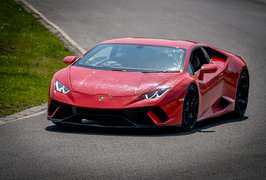 Later, Czinger returned to Laguna Seca to not only beat their own record but to reclaim the throne from the track-special Koenigsegg Jesko Sadair’s Spear. The lap time they achieved was a staggering 1 minute and 22.30 seconds, a time that actually surpasses the fastest MotoAmerica Superbike lap ever recorded at Laguna, which stands at 1 minute