



Aston Martin Valhalla: 2025 Supercar Performance That Redefines Reality
“So, how was it?!”
That’s the question everyone asks when you tell them you’ve just driven the 2026 Aston Martin Valhalla, a nearly $1.1 million supercar with 1,064 horsepower. But reviewing these cars today feels surreal.
I hesitated before answering, because “exactly how you expect it to be” only makes sense if you’ve experienced modern supercars yourself. Here in the 2020s, the supercar world is completely different from the past.
The Long Road to the Valhalla
It’s hard to believe it’s been seven years since Aston Martin first showed the AM-RB 003 at the 2019 Geneva Motor Show. They originally called it that because of their sponsorship with Red Bull Racing.
Aston and Red Bull ended their partnership after the 2020 F1 season. At the same time, Aston Martin changed leadership and developed their own engine. The original plan for a V-6 hybrid powertrain was replaced by a hybrid twin-turbo V-8 based on the Mercedes-AMG GT Black Series. Aston tweaked it with bigger turbos, a new intake manifold, stronger pistons, and different camshafts to increase power by nearly 100 hp and 50 lb-ft. This engine is exclusive to the Valhalla.
When I sat in a prototype at the Pebble Beach Concours in August 2022, the projected output had jumped to 1,012 hp and an undisclosed torque figure. Aston said nothing was final, but I immediately wanted to drive it.
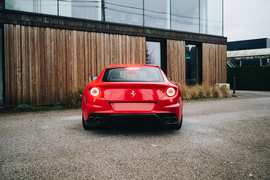 Waiting for the Valhalla
I didn’t expect another three and a half years to pass before I got my chance, but the production version exceeds all those earlier expectations.
The flat-plane-crank, dry-sump, twin-turbo 4.0-liter V-8 produces 817 hp. Combined with 248 hp from two Aston-designed radial-flux permanent-magnet motors on the front axle and a third mounted to the new eight-speed dual-clutch gearbox (an Aston first), the total output is 1,064 hp and 811 lb-ft.
The hybrid system includes a 560-cell battery pack, cooled by immersing the cells in dielectric oil. According to chief engineer Andrew Kay, this allows for “very quick energy cycling,” which is “very good for track use, in particular.”
Unlike the original concept, the production Valhalla is also a plug-in hybrid, capable of EV-only driving for up to 8.7 miles at 80 mph.
The Supercar Evolution
Über-nerdy readers might argue that the Valhalla is a hypercar, not a supercar. But Aston calls it their first mid-engine supercar.
The Valkyrie exists, which restricts how Aston Martin can market “first-ever” achievements. The Valkyrie is barely a street car, and its $3+ million starting price and 285-unit production run make the Valhalla’s $1.1 million price and 999-unit production seem relatively pedestrian.
Of course, that’s absurd in the real world, but it speaks to the current state of high-performance automobiles.
Millennials and Gen Z are used to seeing new million-dollar cars on social media every week, each with incredible power, torque, acceleration, lap times, and a long list of features.
But for older enthusiasts, it’s easy to recall the impact of cars like the 627-hp McLaren F1 in 1993–94, or the Bugatti Veyron 20 years ago—the first million-dollar, 1,000-hp hypercar.
Now? Since I sat in the Valhalla prototype, we’ve driven the Porsche 911 GT3 RS with half the power but massive racing aero and tech that demands pro-racer skills. Ferrari just unveiled the F80, the 849 Testarossa, the Czinger 21C VMax, and the 911 Turbo S. Even a hybrid Corvette ZR1X with 1,250 hp is coming—something nobody would have predicted when Aston Martin and Adrian Newey (now Aston F1 managing technical partner) were developing the Valhalla.
Just Drive It
Waiting for the Valhalla
I didn’t expect another three and a half years to pass before I got my chance, but the production version exceeds all those earlier expectations.
The flat-plane-crank, dry-sump, twin-turbo 4.0-liter V-8 produces 817 hp. Combined with 248 hp from two Aston-designed radial-flux permanent-magnet motors on the front axle and a third mounted to the new eight-speed dual-clutch gearbox (an Aston first), the total output is 1,064 hp and 811 lb-ft.
The hybrid system includes a 560-cell battery pack, cooled by immersing the cells in dielectric oil. According to chief engineer Andrew Kay, this allows for “very quick energy cycling,” which is “very good for track use, in particular.”
Unlike the original concept, the production Valhalla is also a plug-in hybrid, capable of EV-only driving for up to 8.7 miles at 80 mph.
The Supercar Evolution
Über-nerdy readers might argue that the Valhalla is a hypercar, not a supercar. But Aston calls it their first mid-engine supercar.
The Valkyrie exists, which restricts how Aston Martin can market “first-ever” achievements. The Valkyrie is barely a street car, and its $3+ million starting price and 285-unit production run make the Valhalla’s $1.1 million price and 999-unit production seem relatively pedestrian.
Of course, that’s absurd in the real world, but it speaks to the current state of high-performance automobiles.
Millennials and Gen Z are used to seeing new million-dollar cars on social media every week, each with incredible power, torque, acceleration, lap times, and a long list of features.
But for older enthusiasts, it’s easy to recall the impact of cars like the 627-hp McLaren F1 in 1993–94, or the Bugatti Veyron 20 years ago—the first million-dollar, 1,000-hp hypercar.
Now? Since I sat in the Valhalla prototype, we’ve driven the Porsche 911 GT3 RS with half the power but massive racing aero and tech that demands pro-racer skills. Ferrari just unveiled the F80, the 849 Testarossa, the Czinger 21C VMax, and the 911 Turbo S. Even a hybrid Corvette ZR1X with 1,250 hp is coming—something nobody would have predicted when Aston Martin and Adrian Newey (now Aston F1 managing technical partner) were developing the Valhalla.
Just Drive It
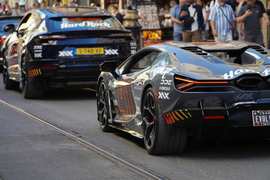 With all these new cars, “comparison is the thief of joy” has never been more relevant in the supercar world. And given how high the dynamic limits are, it’s more satisfying to drive something like the Valhalla on its own merits.
The overall experience matters in a car like this. It can’t just be pleasant on the road and handle like crap on the track, or vice versa. We knew Aston Martin was a winner on all fronts after Angus MacKenzie drove a prototype that was virtually the finished article, save for some transmission calibration.
On the Road
Unlike Angus, who drove it on the Silverstone Circuit, Aston gave me a 50-minute road loop. You might expect a compromise from a Le Mans-style hypercar, but it’s not at all the case.
The only compromise is the lack of luggage space. There are some small door cubbies, but no frunk. That space is occupied by three high-temperature radiators, electric motors, and a racing-style, pushrod-actuated inboard suspension.
Aston used this solution because of the F1-style seating position. You sit so low that a conventional suspension would raise the bodywork too high to maintain a clear sightline. There’s no backrest angle adjustment, so you must adapt to the seating position. The seats are bolted low into the carbon-fiber monocoque tub, so there’s no motor to slide them forward and back. Instead, you pull a leather strap between your legs to adjust your position.
You get used to the driving position quickly—it’s not extreme. Within two miles, you realize the Valhalla-specific Bilstein DTX active damper system and overall suspension setup (five-link rear) make for a very comfortable ride. The Spanish roads weren’t perfect, but the suspension provided a comfortable ride, with minimal difference between Sport and Sport+ settings—a trait we’ve praised on other new Astons, like the Vantage. Race mode offers a harsher ride that might become tiring on mundane drives, but it’s absolutely livable, especially on well-maintained, fast, sweeping roads.
The square steering wheel feels good in your hands, but the molded-in crease/edge on the back that your fingers naturally bend around—meant to give a more positive grip—might not be the most comfortable for everyone. The steering feel itself is intuitive, maintaining a nice weight that’s neither too light nor heavy across various drive modes.
When I came across a long, wide-open country road, I stopped, stood on the brake and throttle, and launch-controlled the Valhalla. After a slight initial wiggle from the rear as the tires hooked up, it was just goooooo. Aston claims 0–62 mph in 2.5 seconds, so figure on 0–60 in 2.4 or 2.3. The speed is no more or less shocking than in other similar cars, but an impressively flat torque curve means 90% of the peak 811 lb-ft is available from 2,500 rpm all the way to the 6,700 rpm power peak. It just never lets up.
If there’s a relative disappointment for supercar/hypercar enthusiasts, it’s the lack of ultra-high revs with a 7,000 rpm redline. The sound is a mix of electric motors, turbos, induction, and exhaust. It’s loud without being over the top, which is satisfying when you open the throttle, but no one will ever list it among the best-sounding engines. There’s just a lot going on, and it’s not always for the better audibly.
Valhalla on the Track
There’s even more going on at the track, in this case Spain’s Circuito de Navarra, a 2.7-mile medium-speed road course with a nice blend of corners, braking zones, and some elevation change. This closed environment, much more than the open road, reveals the power of the Aston Martin Valhalla’s trick torque vectoring, aerodynamics, and monster braking system.
You want to run the car in Race mode, not because of the name, but because of how the hybrid system operates. In Sport+ on the road, drivers don’t usually demand full power in long bursts, so this mode dumps a huge amount of electric boost to the wheels, draining the battery quickly. The brake-by-wire system then recovers it, so you’re ready to go again.
With all these new cars, “comparison is the thief of joy” has never been more relevant in the supercar world. And given how high the dynamic limits are, it’s more satisfying to drive something like the Valhalla on its own merits.
The overall experience matters in a car like this. It can’t just be pleasant on the road and handle like crap on the track, or vice versa. We knew Aston Martin was a winner on all fronts after Angus MacKenzie drove a prototype that was virtually the finished article, save for some transmission calibration.
On the Road
Unlike Angus, who drove it on the Silverstone Circuit, Aston gave me a 50-minute road loop. You might expect a compromise from a Le Mans-style hypercar, but it’s not at all the case.
The only compromise is the lack of luggage space. There are some small door cubbies, but no frunk. That space is occupied by three high-temperature radiators, electric motors, and a racing-style, pushrod-actuated inboard suspension.
Aston used this solution because of the F1-style seating position. You sit so low that a conventional suspension would raise the bodywork too high to maintain a clear sightline. There’s no backrest angle adjustment, so you must adapt to the seating position. The seats are bolted low into the carbon-fiber monocoque tub, so there’s no motor to slide them forward and back. Instead, you pull a leather strap between your legs to adjust your position.
You get used to the driving position quickly—it’s not extreme. Within two miles, you realize the Valhalla-specific Bilstein DTX active damper system and overall suspension setup (five-link rear) make for a very comfortable ride. The Spanish roads weren’t perfect, but the suspension provided a comfortable ride, with minimal difference between Sport and Sport+ settings—a trait we’ve praised on other new Astons, like the Vantage. Race mode offers a harsher ride that might become tiring on mundane drives, but it’s absolutely livable, especially on well-maintained, fast, sweeping roads.
The square steering wheel feels good in your hands, but the molded-in crease/edge on the back that your fingers naturally bend around—meant to give a more positive grip—might not be the most comfortable for everyone. The steering feel itself is intuitive, maintaining a nice weight that’s neither too light nor heavy across various drive modes.
When I came across a long, wide-open country road, I stopped, stood on the brake and throttle, and launch-controlled the Valhalla. After a slight initial wiggle from the rear as the tires hooked up, it was just goooooo. Aston claims 0–62 mph in 2.5 seconds, so figure on 0–60 in 2.4 or 2.3. The speed is no more or less shocking than in other similar cars, but an impressively flat torque curve means 90% of the peak 811 lb-ft is available from 2,500 rpm all the way to the 6,700 rpm power peak. It just never lets up.
If there’s a relative disappointment for supercar/hypercar enthusiasts, it’s the lack of ultra-high revs with a 7,000 rpm redline. The sound is a mix of electric motors, turbos, induction, and exhaust. It’s loud without being over the top, which is satisfying when you open the throttle, but no one will ever list it among the best-sounding engines. There’s just a lot going on, and it’s not always for the better audibly.
Valhalla on the Track
There’s even more going on at the track, in this case Spain’s Circuito de Navarra, a 2.7-mile medium-speed road course with a nice blend of corners, braking zones, and some elevation change. This closed environment, much more than the open road, reveals the power of the Aston Martin Valhalla’s trick torque vectoring, aerodynamics, and monster braking system.
You want to run the car in Race mode, not because of the name, but because of how the hybrid system operates. In Sport+ on the road, drivers don’t usually demand full power in long bursts, so this mode dumps a huge amount of electric boost to the wheels, draining the battery quickly. The brake-by-wire system then recovers it, so you’re ready to go again.
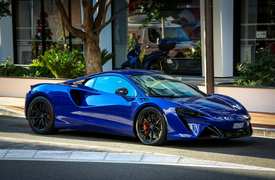 However, on a track, when you’re constantly pressing the throttle as quickly, hard, and often as possible, Race mode meters the electric assist via a recharge strategy that holds back up to 15% state of charge to prevent you from running out and having to rely only on the combustion engine. According to Kay, this results in a typical total loss of 15–20 hp, perhaps a maximum of 30, simply to prevent the battery from ever reaching zero charge. “In Sport+ on a track, you will get more noticeable reduced performance after a lap or two because it will start reining it in because it derates [the battery], but Race mode never does that—it