



The Czinger 21C VMax: A 1,250-Horsepower Testament to Innovation
In the realm of high-end motoring, the pursuit of extreme performance often pushes the boundaries of what is technically possible. The Czinger 21C VMax, a hypercar born from the revolutionary engineering of Divergent Technologies, represents not just a peak in automotive performance but a paradigm shift in vehicle construction. This remarkable machine, engineered and built in the heart of Southern California, embodies a future where every gram of weight is a liability and every pound of thrust is a necessity.
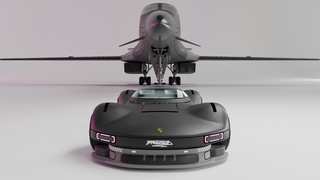 For years, the automotive world has been eager to experience the 21C platform firsthand. The concept of a center-steer, tandem two-seater utilizing cutting-edge 3D printing and AI had long been the subject of speculation. When the opportunity arose to embark on a 500-mile road rally through Northern California’s wine country, it offered a unique perspective that went beyond the traditional track-focused narrative. While a track story is certainly compelling, the real test lies in the daily life of such a vehicle, particularly one that challenges conventional automotive design.
Factory Fresh: A Glimpse into the Future
Stepping into the Czinger factory felt less like entering a production line and more like entering a high-tech laboratory. The parent company, Divergent Technologies, leverages iterative artificial intelligence and advanced 3D printers to engineer components of unprecedented lightness and strength. It is fitting that a driver’s U.S. passport is required to enter the facility, as Divergent Technologies also serves as a critical supplier to the Department of Defense. While military hardware remained discreet during the visit, the sheer scale of the 3D printing operation was astounding. One particular printer, capable of zapping powdered aluminum into shapes resembling bird bones, offered a stark glimpse into the future of automotive manufacturing.
Lukas Czinger, the young CEO of both companies, explained that the technology has reached what he calls the “Pareto optimal” point—the threshold beyond which any marginal increase or decrease in weight yields negative returns. Take, for instance, a simple component such as a remote reservoir for a rear suspension damper. The engineering challenge is to design a part that fits a specific space and withstands forces stronger than the target weight. Using these parameters, the software iterates through hundreds of thousands of designs, ultimately identifying the lightest, strongest shape. It is akin to the evolutionary process accelerated to warp speed. Beyond the DOD, nine automotive OEMs utilize Divergent’s 3D-printed parts, including Aston Martin (DBR22 Roadster), Bugatti (Tourbillon), and McLaren (W1), although the Ferrari F80’s control arms also appear to be suspect candidates.
Under the Carbon Fiber: Engineering the Hybrid Hypercar
Czinger offers two versions of what is essentially the same car: the high-downforce track monster known as the 21C (named after the 21st century) and the wingless, long-tailed VMax. Technically, the VMax is designated the 21C VMax, but the “21C” branding is absent from the vehicle’s exterior. For the inaugural Velocity Tour, a 500-mile road rally through California’s wine country, the VMax variant was piloted.
The term “piloting” is used intentionally, as the interior feels more like a cockpit than a conventional greenhouse. Czinger touts the resemblance to a fighter jet, and while I may not have flown one, I have experienced the claustrophobic intimacy of an Extra 330LT stunt plane. The similarity is palpable; there is glass positioned less than a foot away from both sides of the occupant’s head. The visibility is exceptional, but the process of entering and exiting the car is equally ridiculous: you must sit with your legs facing outward on the massive sill, pull your knees toward your chest and pivot your body as you tuck your feet into the footwell, then duck your head under the roof.
For years, the automotive world has been eager to experience the 21C platform firsthand. The concept of a center-steer, tandem two-seater utilizing cutting-edge 3D printing and AI had long been the subject of speculation. When the opportunity arose to embark on a 500-mile road rally through Northern California’s wine country, it offered a unique perspective that went beyond the traditional track-focused narrative. While a track story is certainly compelling, the real test lies in the daily life of such a vehicle, particularly one that challenges conventional automotive design.
Factory Fresh: A Glimpse into the Future
Stepping into the Czinger factory felt less like entering a production line and more like entering a high-tech laboratory. The parent company, Divergent Technologies, leverages iterative artificial intelligence and advanced 3D printers to engineer components of unprecedented lightness and strength. It is fitting that a driver’s U.S. passport is required to enter the facility, as Divergent Technologies also serves as a critical supplier to the Department of Defense. While military hardware remained discreet during the visit, the sheer scale of the 3D printing operation was astounding. One particular printer, capable of zapping powdered aluminum into shapes resembling bird bones, offered a stark glimpse into the future of automotive manufacturing.
Lukas Czinger, the young CEO of both companies, explained that the technology has reached what he calls the “Pareto optimal” point—the threshold beyond which any marginal increase or decrease in weight yields negative returns. Take, for instance, a simple component such as a remote reservoir for a rear suspension damper. The engineering challenge is to design a part that fits a specific space and withstands forces stronger than the target weight. Using these parameters, the software iterates through hundreds of thousands of designs, ultimately identifying the lightest, strongest shape. It is akin to the evolutionary process accelerated to warp speed. Beyond the DOD, nine automotive OEMs utilize Divergent’s 3D-printed parts, including Aston Martin (DBR22 Roadster), Bugatti (Tourbillon), and McLaren (W1), although the Ferrari F80’s control arms also appear to be suspect candidates.
Under the Carbon Fiber: Engineering the Hybrid Hypercar
Czinger offers two versions of what is essentially the same car: the high-downforce track monster known as the 21C (named after the 21st century) and the wingless, long-tailed VMax. Technically, the VMax is designated the 21C VMax, but the “21C” branding is absent from the vehicle’s exterior. For the inaugural Velocity Tour, a 500-mile road rally through California’s wine country, the VMax variant was piloted.
The term “piloting” is used intentionally, as the interior feels more like a cockpit than a conventional greenhouse. Czinger touts the resemblance to a fighter jet, and while I may not have flown one, I have experienced the claustrophobic intimacy of an Extra 330LT stunt plane. The similarity is palpable; there is glass positioned less than a foot away from both sides of the occupant’s head. The visibility is exceptional, but the process of entering and exiting the car is equally ridiculous: you must sit with your legs facing outward on the massive sill, pull your knees toward your chest and pivot your body as you tuck your feet into the footwell, then duck your head under the roof.
 One reason for the large sills is their hidden contents: batteries. The 21C VMax is a hybrid hypercar, with each sill containing 2.2 kWh of battery capacity, for a total of 4.4 kWh. The car is not a plug-in hybrid; rather, a motor powered by the mid-mounted V8 engine maintains the battery charge. These batteries deliver up to 500 horsepower to the front axle, which features one electric motor per wheel. The petrol-powered heart of the car is a Czinger-designed 2.9-liter twin-turbo V8 engine that produces 750 horsepower on California’s standard 91-octane premium gasoline. Pouring 100-octane race fuel into the tank increases the horsepower to 850 hp. The compact yet powerful engine can also operate on ethanol, generating even more power, although Czinger has not publicly released these figures—we anticipate a 10% increase.
The combustion engine drives the rear wheels through an Xtrac single-clutch automated semi-sequential gearbox. This setup is reminiscent of the Xtrac seven-speed used in the Pagani Utopia. However, Czinger not only 3D prints the transmission housing but also employs small 48-volt electric motors to execute quicker shifts at low speeds. This innovation eliminates the “drunk” or “jerky” feeling that plagues all other automated single-clutch gearboxes at low speeds. The twin-barrel actuators work as advertised in low-speed situations, as I was thankful to discover. Maneuvering into gas stations, restaurants, and hotel parking lots felt almost normal. Truly, bravo to Czinger for this engineering feat.
Track Time: Push to the Edge
Navigating the winding back roads of California for the Velocity Tour provided a unique perspective on the Czinger 21C VMax. For much of the event, a professional driver, Evan Jacobs, occupied the seat behind the driver. As is common practice with certain high-end hypercars like Bugatti and Pagani, Czinger ensures a professional is present to monitor performance and ensure safety. Thankfully, Jacobs later assured the Czinger team that I posed no threat to the vehicle and was permitted to drive solo for the remainder of the rally. We made a stop at Laguna Seca for some parade laps, but due to restrictions, non-Czinger employees are not allowed to drive the VMax on racetracks, even at the slow pace mandated by the rally.
As I have learned the hard way, even if you cannot drive, a passenger experience is often just as enlightening. I squeezed into the unconventional rear seat, and the first crucial observation is about legroom: if you have large calves or feet, the rear-seat experience is less than ideal. My XXL calves felt wedged between the carbon-fiber tub and the carbon-fiber seat, and my feet did not fit comfortably. However, the visibility through the side windows is incredible. Again, it reminded me of a stunt plane, and it was a novel way to experience a track—something I have done over a thousand times.
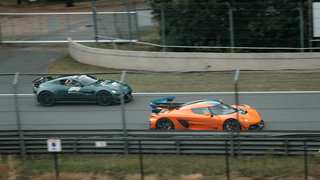
This was especially true when Jacobs and I convinced the Skip Barber Racing School staff (whose track day we were crashing) to let him take the VMax for a couple of “6/10ths” hot laps. The most impressive passenger lap I’ve ever experienced was riding shotgun in an Aston Martin Valkyrie LMH race car, during which I could feel the blood pooling in my extremities under hard braking. The Czinger VMax is now a close second, and remember, Jacobs didn’t even push the car to its limits. Even at something less than the limit and without the high-downforce rear wing, it was easy to understand how the Czinger 21C achieved what the brand calls the California Gold Rush. This feat involved setting five production car track records—at Thunder Hill, Sonoma Raceway, Laguna Seca, Willow Springs, and the Thermal Club—in five days, driving from each track to the next. Later, Czinger returned to Laguna Seca to not only beat its own record but to reclaim the throne from the track-special Koenigsegg Jesko Sadair’s Spear. That lap time, a staggering 1 minute, 22.30 seconds, is quicker than the fastest MotoAmerica Superbike lap ever recorded at Laguna, a 1:22.56.
Czinger claims a vehicle weight of approximately 3,600 pounds, which is remarkably light for a 1,250-horsepower hybrid. For context, the Ferrari SF90 Stradale Asseto Fiorano—the highest-performance version of a three-motor, twin-turbo V8 PHEV that produces only 986 horsepower—weighs 3,839 pounds. The new Lamborghini Temerario is another example of a three-motor, twin-turbo V8 (producing less power, but you get the comparison) that pushes well past the two-ton mark, weighing in at 4,185 pounds.
One reason for the large sills is their hidden contents: batteries. The 21C VMax is a hybrid hypercar, with each sill containing 2.2 kWh of battery capacity, for a total of 4.4 kWh. The car is not a plug-in hybrid; rather, a motor powered by the mid-mounted V8 engine maintains the battery charge. These batteries deliver up to 500 horsepower to the front axle, which features one electric motor per wheel. The petrol-powered heart of the car is a Czinger-designed 2.9-liter twin-turbo V8 engine that produces 750 horsepower on California’s standard 91-octane premium gasoline. Pouring 100-octane race fuel into the tank increases the horsepower to 850 hp. The compact yet powerful engine can also operate on ethanol, generating even more power, although Czinger has not publicly released these figures—we anticipate a 10% increase.
The combustion engine drives the rear wheels through an Xtrac single-clutch automated semi-sequential gearbox. This setup is reminiscent of the Xtrac seven-speed used in the Pagani Utopia. However, Czinger not only 3D prints the transmission housing but also employs small 48-volt electric motors to execute quicker shifts at low speeds. This innovation eliminates the “drunk” or “jerky” feeling that plagues all other automated single-clutch gearboxes at low speeds. The twin-barrel actuators work as advertised in low-speed situations, as I was thankful to discover. Maneuvering into gas stations, restaurants, and hotel parking lots felt almost normal. Truly, bravo to Czinger for this engineering feat.
Track Time: Push to the Edge
Navigating the winding back roads of California for the Velocity Tour provided a unique perspective on the Czinger 21C VMax. For much of the event, a professional driver, Evan Jacobs, occupied the seat behind the driver. As is common practice with certain high-end hypercars like Bugatti and Pagani, Czinger ensures a professional is present to monitor performance and ensure safety. Thankfully, Jacobs later assured the Czinger team that I posed no threat to the vehicle and was permitted to drive solo for the remainder of the rally. We made a stop at Laguna Seca for some parade laps, but due to restrictions, non-Czinger employees are not allowed to drive the VMax on racetracks, even at the slow pace mandated by the rally.
As I have learned the hard way, even if you cannot drive, a passenger experience is often just as enlightening. I squeezed into the unconventional rear seat, and the first crucial observation is about legroom: if you have large calves or feet, the rear-seat experience is less than ideal. My XXL calves felt wedged between the carbon-fiber tub and the carbon-fiber seat, and my feet did not fit comfortably. However, the visibility through the side windows is incredible. Again, it reminded me of a stunt plane, and it was a novel way to experience a track—something I have done over a thousand times.
This was especially true when Jacobs and I convinced the Skip Barber Racing School staff (whose track day we were crashing) to let him take the VMax for a couple of “6/10ths” hot laps. The most impressive passenger lap I’ve ever experienced was riding shotgun in an Aston Martin Valkyrie LMH race car, during which I could feel the blood pooling in my extremities under hard braking. The Czinger VMax is now a close second, and remember, Jacobs didn’t even push the car to its limits. Even at something less than the limit and without the high-downforce rear wing, it was easy to understand how the Czinger 21C achieved what the brand calls the California Gold Rush. This feat involved setting five production car track records—at Thunder Hill, Sonoma Raceway, Laguna Seca, Willow Springs, and the Thermal Club—in five days, driving from each track to the next. Later, Czinger returned to Laguna Seca to not only beat its own record but to reclaim the throne from the track-special Koenigsegg Jesko Sadair’s Spear. That lap time, a staggering 1 minute, 22.30 seconds, is quicker than the fastest MotoAmerica Superbike lap ever recorded at Laguna, a 1:22.56.
Czinger claims a vehicle weight of approximately 3,600 pounds, which is remarkably light for a 1,250-horsepower hybrid. For context, the Ferrari SF90 Stradale Asseto Fiorano—the highest-performance version of a three-motor, twin-turbo V8 PHEV that produces only 986 horsepower—weighs 3,839 pounds. The new Lamborghini Temerario is another example of a three-motor, twin-turbo V8 (producing less power, but you get the comparison) that pushes well past the two-ton mark, weighing in at 4,185 pounds.
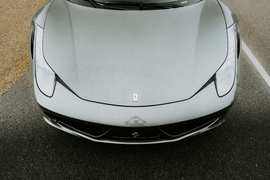 It is worth noting that the SF90 and Temerario are the two fastest gasoline-powered cars MotorTrend has ever tested (the Ferrari for 0–60 mph and the Lambo for the quarter mile). If Czinger’s weight claims prove accurate, this unorthodox California startup has managed to outperform two Italian legends with its debut production vehicle. This is remarkable in itself, but even more noteworthy considering that Southern California is known for many things, but there isn’t a deep well of supercar manufacturing