



Aston Martin Valhalla Review: The 2025 Supercar That Defies Expectations
The modern supercar landscape is a relentless assault on the senses. Every new model boasts dizzying power figures, insane acceleration times, and enough cutting-edge technology to fill a small server farm. It’s easy to become desensitized to the hype, to assume that anything labeled a “hypercar” or a “supercar” will simply be a carbon-fiber monster that demands the skills of a professional race car driver. After a recent drive in the 2026 Aston Martin Valhalla, I can confirm that this sentiment is not only wrong but frankly insulting to the engineering mastery on display.
Aston Martin’s Valhalla is not just another hypercar; it’s a benchmark for what modern performance engineering can achieve. With a combined output of 1,064 horsepower from a hybridized V-8 and electric motors, it stands among the elite in the rarefied world of hybrid hypercars. Yet, despite the stratospheric power and cutting-edge technology, the Valhalla delivers a driving experience that is refreshingly, almost shockingly, user-friendly. It’s a supercar that leaves you questioning reality, not in a terrifying way, but in an awe-inspiring one.
A Long-Anticipated Debut
It’s been nearly seven years since Aston Martin first unveiled the AM-RB 003 at the 2019 Geneva Motor Show. The original name, a nod to the automaker’s former ties with Red Bull Racing Formula 1, reflected a world that feels like a lifetime ago. Back then, the plan was to utilize an in-house-designed 3.0-liter V-6 hybrid system. However, a lot has changed since 2019.
 Aston Martin and Red Bull parted ways after the 2020 F1 season when Lawrence Stroll acquired the team and rebranded it as Aston Martin F1. More significantly, the automotive landscape has evolved dramatically. Amidst internal turbulence at Aston Martin, the Valhalla’s powertrain shifted from a planned V-6 to a hybrid system based on the Mercedes-AMG GT Black Series. Aston engineers gifted the V-8 with larger turbos, a new inlet manifold, stronger pistons, and different camshafts, boosting its output by nearly 100 hp and 50 lb-ft of torque. This engine is now exclusive to the Valhalla.
When I sat in a mockup of the car on the Pebble Beach Concours’ lawn in August 2022, the projected specs for the V-8-based powertrain had jumped from a combined 937 hp and 738 lb-ft of torque to 1,012 hp and an undisclosed torque figure. Even though the specs were preliminary, I knew then that the Valhalla was going to be something special. “Please, I want to drive it, whenever it’s ready,” I told the Aston team.
Worth the Wait
Based on Aston Martin’s initial timeline, I expected to get behind the wheel of the Valhalla sooner, but the production version’s hardware exceeded even those early expectations. The flat-plane-crank, dry-sump, twin-turbo 4.0-liter V-8 now produces a staggering 817 hp. This is supplemented by two Aston-designed radial-flux permanent-magnet motors on the front axle and a third mounted to the new eight-speed dual-clutch gearbox, providing a combined 248 hp. The result is a total output of 1,064 hp and 811 lb-ft of torque.
The hybrid system includes a 560-cell battery pack, which engineers say is an off-the-shelf AMG unit. The cells are submerged in dielectric oil, allowing for rapid charging and deployment of electrical energy. This is particularly advantageous for track performance, ensuring consistent power delivery lap after lap.
Unlike the original concept and its Valkyrie stablemate, the production Valhalla is also a plug-in hybrid. It can run in EV-only mode for up to 8.7 miles, reaching speeds of 80 mph. For enthusiasts who want to dive deep into the technical details, this is a hybrid hypercar that pushes the boundaries of performance, efficiency, and road usability.
Redefining the “Supercar”
Some readers may take umbrage with the use of the term “supercar,” but Aston Martin itself refers to the Valhalla as its first-ever mid-engine supercar. However, with the existence of the Valkyrie, marketing descriptions are confined to using the term “super” rather than “hyper.” Regardless, the Valkyrie is barely a street car, with a price tag exceeding $3 million and only 285 units produced. In comparison, the Valhalla’s million-and-change MSRP and 999-unit production run seem relatively pedestrian—absurd, yes, but indicative of the escalating cost and capability of modern high-performance automobiles.
For younger generations accustomed to social media feeds filled with new million-dollar cars, the relentless barrage of unprecedented power, acceleration, and technology might seem routine. But for those of us with a longer memory, it’s easy to recall the shockwave caused by the 627 hp, $800,000 McLaren F1 in 1993-94. And even more so the Bugatti Veyron just 20 years ago, the car generally considered the first million-dollar, 1,000-hp hypercar.
Today? Since I sat in the Valhalla prototype at Pebble Beach, we’ve driven the Porsche 911 GT3 RS with about half the horsepower and less “exotic” tech but with so much racing-derived aerodynamics and hardware that it requires pro-racer skills to maximize on track. Its suitability as a road car, given its suspension setup, is debatable.
Aston Martin and Red Bull parted ways after the 2020 F1 season when Lawrence Stroll acquired the team and rebranded it as Aston Martin F1. More significantly, the automotive landscape has evolved dramatically. Amidst internal turbulence at Aston Martin, the Valhalla’s powertrain shifted from a planned V-6 to a hybrid system based on the Mercedes-AMG GT Black Series. Aston engineers gifted the V-8 with larger turbos, a new inlet manifold, stronger pistons, and different camshafts, boosting its output by nearly 100 hp and 50 lb-ft of torque. This engine is now exclusive to the Valhalla.
When I sat in a mockup of the car on the Pebble Beach Concours’ lawn in August 2022, the projected specs for the V-8-based powertrain had jumped from a combined 937 hp and 738 lb-ft of torque to 1,012 hp and an undisclosed torque figure. Even though the specs were preliminary, I knew then that the Valhalla was going to be something special. “Please, I want to drive it, whenever it’s ready,” I told the Aston team.
Worth the Wait
Based on Aston Martin’s initial timeline, I expected to get behind the wheel of the Valhalla sooner, but the production version’s hardware exceeded even those early expectations. The flat-plane-crank, dry-sump, twin-turbo 4.0-liter V-8 now produces a staggering 817 hp. This is supplemented by two Aston-designed radial-flux permanent-magnet motors on the front axle and a third mounted to the new eight-speed dual-clutch gearbox, providing a combined 248 hp. The result is a total output of 1,064 hp and 811 lb-ft of torque.
The hybrid system includes a 560-cell battery pack, which engineers say is an off-the-shelf AMG unit. The cells are submerged in dielectric oil, allowing for rapid charging and deployment of electrical energy. This is particularly advantageous for track performance, ensuring consistent power delivery lap after lap.
Unlike the original concept and its Valkyrie stablemate, the production Valhalla is also a plug-in hybrid. It can run in EV-only mode for up to 8.7 miles, reaching speeds of 80 mph. For enthusiasts who want to dive deep into the technical details, this is a hybrid hypercar that pushes the boundaries of performance, efficiency, and road usability.
Redefining the “Supercar”
Some readers may take umbrage with the use of the term “supercar,” but Aston Martin itself refers to the Valhalla as its first-ever mid-engine supercar. However, with the existence of the Valkyrie, marketing descriptions are confined to using the term “super” rather than “hyper.” Regardless, the Valkyrie is barely a street car, with a price tag exceeding $3 million and only 285 units produced. In comparison, the Valhalla’s million-and-change MSRP and 999-unit production run seem relatively pedestrian—absurd, yes, but indicative of the escalating cost and capability of modern high-performance automobiles.
For younger generations accustomed to social media feeds filled with new million-dollar cars, the relentless barrage of unprecedented power, acceleration, and technology might seem routine. But for those of us with a longer memory, it’s easy to recall the shockwave caused by the 627 hp, $800,000 McLaren F1 in 1993-94. And even more so the Bugatti Veyron just 20 years ago, the car generally considered the first million-dollar, 1,000-hp hypercar.
Today? Since I sat in the Valhalla prototype at Pebble Beach, we’ve driven the Porsche 911 GT3 RS with about half the horsepower and less “exotic” tech but with so much racing-derived aerodynamics and hardware that it requires pro-racer skills to maximize on track. Its suitability as a road car, given its suspension setup, is debatable.
 Stepping up in price, construction, and technological prowess, MotorTrend has sampled the Ferrari F80, the 849 Testarossa, the Czinger 21C VMax, and even the more “run of the mill but dizzyingly fast” Porsche 911 Turbo S, to name just a few. There’s even a hybrid Corvette ZR1X with 1,250 hp that nobody saw coming when the Valhalla was just a brilliant idea in the minds of Aston Martin and then-Red Bull F1 design legend (and now Aston F1 managing technical partner) Adrian Newey.
Just Drive It
With all this in mind, “comparison is the thief of joy” has never been more appropriate in the world of supercars. It’s also coincidental because orchestrating a proper comparison test among the vehicles listed above, other than the ZR1X, is virtually impossible due to Maranello’s longstanding aversion to supplying publications like ours with cars for head-to-head showdowns. (Shame on you, Ferrari.)
No matter, because given how high the dynamic limits are, it’s far more satisfying to drive something like the Valhalla on its own merits and for whatever experience it provides.
On the Road
Despite its quasi-Le Mans Hypercar appearance and low, wide stance, the Valhalla isn’t a compromised daily driver. The only real drawback is the lack of luggage storage; while there are some small cubbies in the door cards, there’s no frunk because that space is occupied by three high-temp radiators, the electric motors, and a racing-style, pushrod-actuated horizontally mounted inboard suspension.
Aston achieved this suspension layout in part due to the F1-style driving position. You sit so low that a conventional suspension would have raised the bodywork too much to maintain an clear sightline ahead. There’s no backrest angle adjustment, so you must adapt to the seating position. The seats are bolted so low into the carbon-fiber monocoque tub that there’s no motor to slide them forward and back. Instead, you pull a leather strap between your legs and push to move the seat.
You get used to the driving position quickly—it’s not that extreme—and within two miles you realize the Valhalla-specific Bilstein DTX active damper system and overall suspension setup make for a remarkably comfortable megacar. The Spanish road route we drove wasn’t exactly smooth, but neither was it perfectly manicured. Still, there wasn’t a huge difference between the Sport and Sport+ suspension settings—a welcome trait we’ve praised on other new Astons, like the Vantage. Race mode introduces a harsher ride you might grow tired of in mundane cruising, but you can live with it, too, especially on well-maintained, fast, sweeping roads when it’s playtime.
The square-ish steering wheel feels mostly nice to use, but the molded-in crease/edge running vertically up the back of the grip—to provide a more positive grip than a rounded surface—may not be the most comfortable for everyone. The steering feel itself is intuitive, maintaining a nice weight that’s neither too light nor too heavy across different drive modes.
Stepping up in price, construction, and technological prowess, MotorTrend has sampled the Ferrari F80, the 849 Testarossa, the Czinger 21C VMax, and even the more “run of the mill but dizzyingly fast” Porsche 911 Turbo S, to name just a few. There’s even a hybrid Corvette ZR1X with 1,250 hp that nobody saw coming when the Valhalla was just a brilliant idea in the minds of Aston Martin and then-Red Bull F1 design legend (and now Aston F1 managing technical partner) Adrian Newey.
Just Drive It
With all this in mind, “comparison is the thief of joy” has never been more appropriate in the world of supercars. It’s also coincidental because orchestrating a proper comparison test among the vehicles listed above, other than the ZR1X, is virtually impossible due to Maranello’s longstanding aversion to supplying publications like ours with cars for head-to-head showdowns. (Shame on you, Ferrari.)
No matter, because given how high the dynamic limits are, it’s far more satisfying to drive something like the Valhalla on its own merits and for whatever experience it provides.
On the Road
Despite its quasi-Le Mans Hypercar appearance and low, wide stance, the Valhalla isn’t a compromised daily driver. The only real drawback is the lack of luggage storage; while there are some small cubbies in the door cards, there’s no frunk because that space is occupied by three high-temp radiators, the electric motors, and a racing-style, pushrod-actuated horizontally mounted inboard suspension.
Aston achieved this suspension layout in part due to the F1-style driving position. You sit so low that a conventional suspension would have raised the bodywork too much to maintain an clear sightline ahead. There’s no backrest angle adjustment, so you must adapt to the seating position. The seats are bolted so low into the carbon-fiber monocoque tub that there’s no motor to slide them forward and back. Instead, you pull a leather strap between your legs and push to move the seat.
You get used to the driving position quickly—it’s not that extreme—and within two miles you realize the Valhalla-specific Bilstein DTX active damper system and overall suspension setup make for a remarkably comfortable megacar. The Spanish road route we drove wasn’t exactly smooth, but neither was it perfectly manicured. Still, there wasn’t a huge difference between the Sport and Sport+ suspension settings—a welcome trait we’ve praised on other new Astons, like the Vantage. Race mode introduces a harsher ride you might grow tired of in mundane cruising, but you can live with it, too, especially on well-maintained, fast, sweeping roads when it’s playtime.
The square-ish steering wheel feels mostly nice to use, but the molded-in crease/edge running vertically up the back of the grip—to provide a more positive grip than a rounded surface—may not be the most comfortable for everyone. The steering feel itself is intuitive, maintaining a nice weight that’s neither too light nor too heavy across different drive modes.
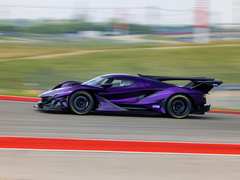 When I came across a long, wide-open stretch of country road with no one in sight, I brought the car to a stop, stood on the brake and throttle pedals, and launch-controlled the Valhalla as hard as it would go. Other than an initial slight, slidy wiggle from the rear as the tires tried to hook up, it was simply a matter of goooooo. Aston claims 0–62 mph in 2.5 seconds, so figure on a 0–60 run of 2.4, maybe 2